



Introduction
In Summer 2025 my grandmother was admitted to a care home specialising in dementia, and I watched someone whose memory had shaped my own begin to lose access to hers — first names, then places, then the thread of narrative itself. Memories she had told me a hundred times began to arrive in altered forms, if they arrived at all. I wanted to work with memory not as a subject to be depicted but as a material to be processed — specifically, with its instability: the way it bends, substitutes, forgets, and reconstructs. Before deciding what to make, I needed to understand what was actually happening in her brain, and by extension in every brain.
The Memory
Memory can be interrogated from two directions at once: philosophers ask what it means for a memory to belong to a person, and neuroscientists ask what memory is as a mechanism and what happens when that mechanism fails. The project takes both seriously — the scientific ground first, then the philosophical one.
The scientific perspective
Memory formation runs through four neural stages, each a distinct site of failure. In encoding, the hippocampus binds sensory input into an associative trace, held at the cellular level by long-term potentiation. In consolidation, the trace is replayed and transferred to cortical storage — details fade, patterns generalise. In storage, the memory lives as an engram: a configuration of synaptic weights rather than a localised record. In retrieval, recall re-activates a configuration similar to, but never identical with, the original — and each recall slightly alters the trace. This is reconstructive memory.
Dementia attacks encoding and retrieval through hippocampal degeneration — amyloid-β plaques, lost synaptic connections, a sharp decline in adult neurogenesis — so the substrate degrades much like a neural network losing connections: not silence, but fluent inaccuracy. The most revealing part is not what is lost but what replaces it. Memory becomes generative through three mechanisms: semantic paraphasia (a related word substituted for the intended one — “aunt” for “sister”), confabulation (gaps filled with fluent, confident invention the speaker fully believes), and déjà vécu (the conviction that a novel experience has already been lived). All three are the healthy reconstructive process, amplified. Dementia does not introduce distortion; it reveals it.
The philosophical perspective
Three thinkers frame what it means for an altered memory to still be a memory. Locke held that the self is constituted by the continuity of memory — a thread stitched together by recollection; if identity is memory, the dissolution of memory is, quite literally, the unravelling of the self. Parfit weakened that into psychological continuity — overlapping chains of memory, intention, and personality — making identity a matter of degree; minor drift is survivable, and the question becomes where the overlap grows too thin. Ricoeur went further still: identity is narrative, a story we continually revise. A story can tolerate revision; it cannot tolerate incoherence — which is the exact failure mode of dementia. The Botanist stages this in a single interaction: you submit a memory and receive not a rendering of it but its altered form, and whether the returned image is still yours, or belongs to the branch your memory collapsed into, is a live question the artefact deliberately does not answer.
The Concept
The aim was a mechanism that does to a memory what memory does to itself. You type a memory into a text field; the machine substitutes some words, leaves others alone, and produces an image — not a picture of what you wrote, but of the altered version, the thing your memory might become after years of re-telling. The artwork has three components: an algorithm, a web interface to navigate through, and a generated image at the end.
The Inspiration
Three artists shaped the work, each engaging memory loss from a different angle — Matt Komo emotionally, as witness; Refik Anadol technically, as data; Claude Monet stylistically, as a visual language of perception rather than reproduction.
Matt Komo · A Forgotten Life
Komo's short documentary is an intimate portrait of his grandfather Joe, whose Alzheimer's had progressed severely; Komo paused his commercial career to make it, driven by the conviction that he'd regret missing the window. It opens on a question — “where does a memory go when it dies?” — and never treats memory loss as abstraction. It dwells inside that question rather than answering it, which suggested memory loss could be approached as an experiential and emotional reality to be given form.
Refik Anadol · Melting & Quantum Memories
Anadol's core idea is that data has an aesthetic and can be made to feel. In Melting Memories (2018), EEG data from subjects recalling a childhood memory was rendered as morphing, cloud-like forms — the proposition that reconstruction itself has a shape that can be externalised as image. In Quantum Memories (2020), he fed 200 million nature photographs and Google's quantum data into a generative model, using quantum noise — genuine subatomic randomness, not a simulation — as the generative seed, framed by the Many-Worlds Interpretation in which every measurement spawns a parallel reality. The Botanist draws from both: memory externalised as image, quantum computation as a non-deterministic engine, and Many-Worlds as the frame for reading an output not as a correct answer but as a branch.
Claude Monet · Woman with a Parasol
Monet painted his wife Camille with a parasol in 1875 — sharp, specific, individual: a memory at the moment it is being formed. Eleven years later, and seven after her death, he painted two reworkings of the same composition using Suzanne Hoschedé as the armature, her face deliberately dissolved into something blurred and anonymous — memory as drift rather than replica, partial persistence rather than total loss. The two 1886 paintings don't behave like copies but like branches: same structural trace — woman, parasol, hillside, sky — diverging in posture and atmosphere. Monet belongs in this project because his paintings show that memory can remain emotionally true even when it is no longer visually exact.
The Botanist
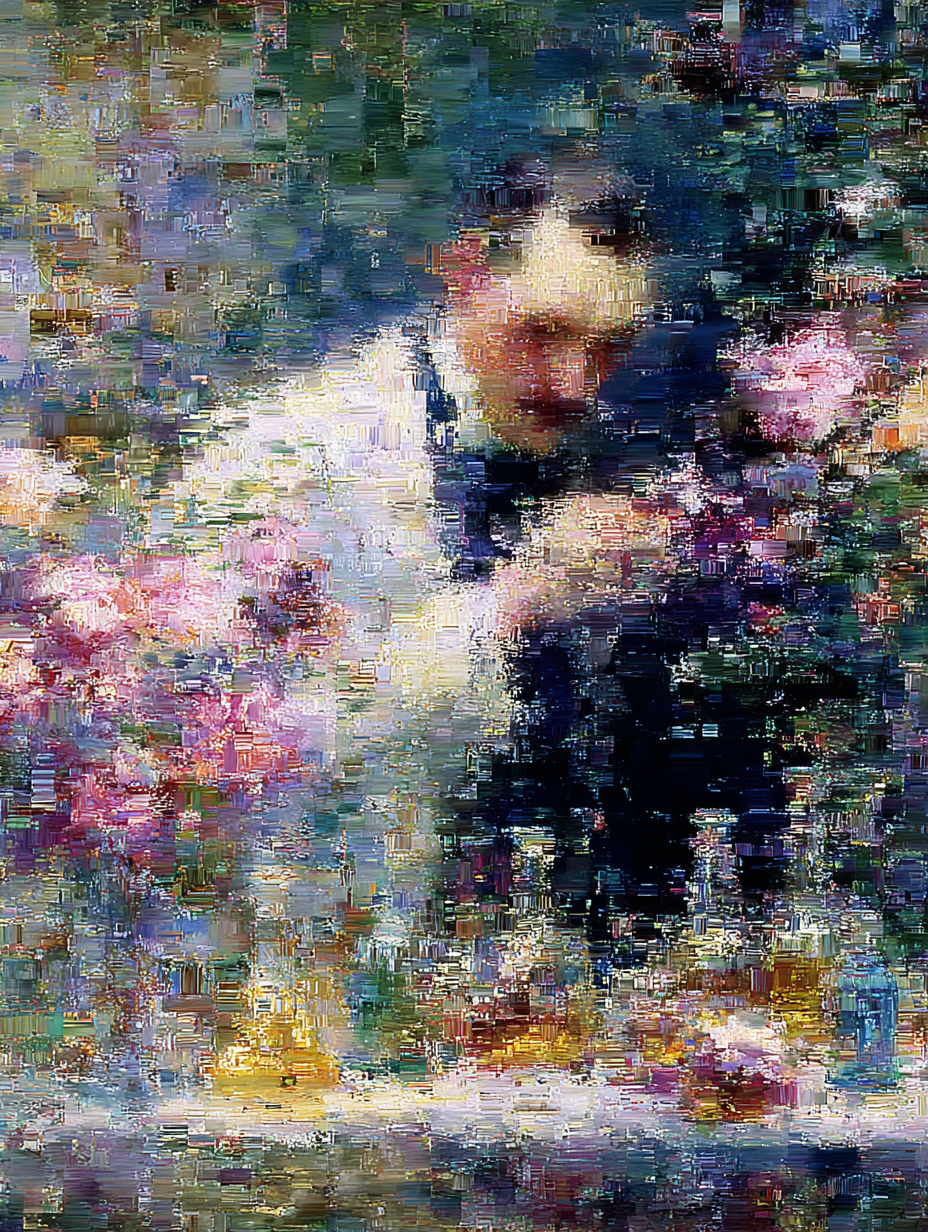
I used Midjourney to explore what the project would look like. While testing the visual register, a figure kept appearing that I hadn't prompted for — an older man, partially visible, surrounded by greenery and flowers, with soft posture and attention on living material. He felt, unmistakably, like a botanist. That is where the name came from.
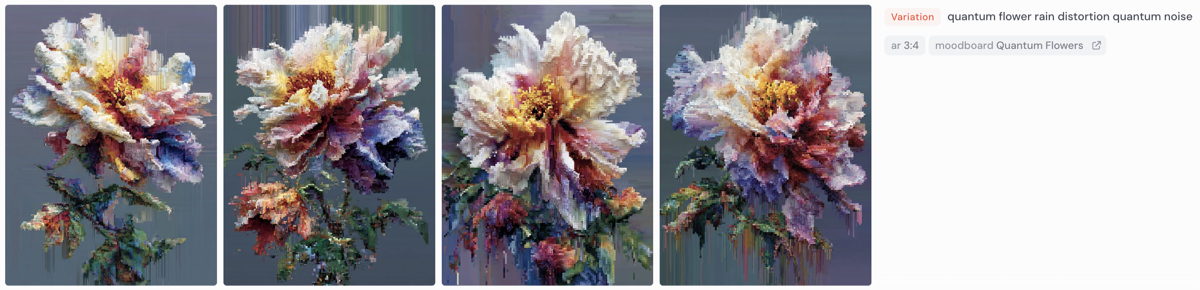
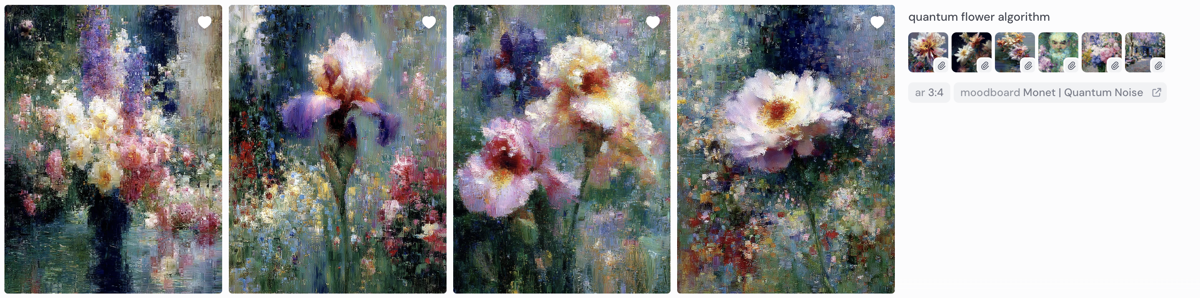
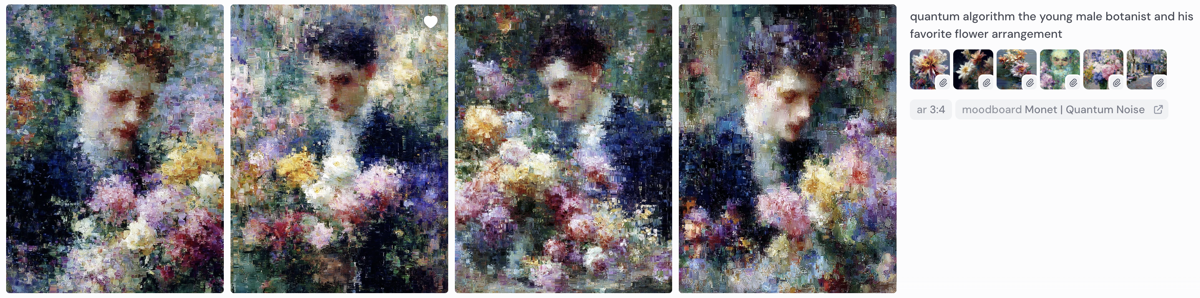
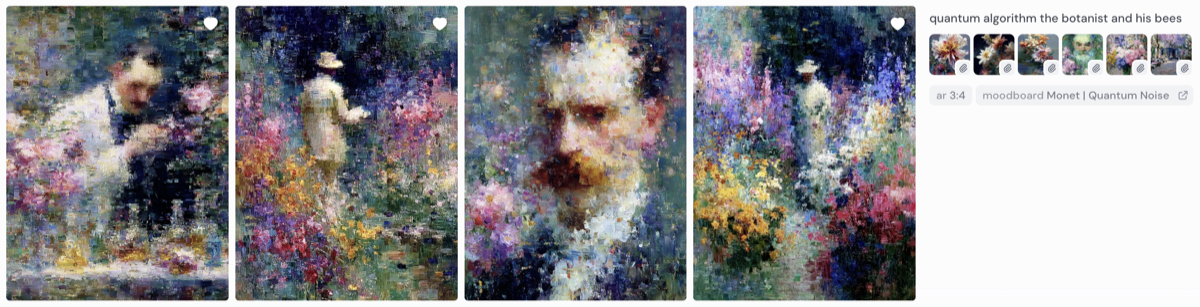
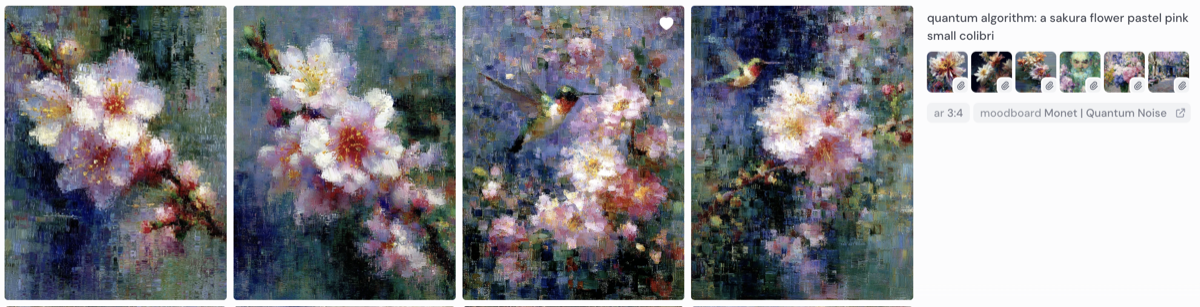
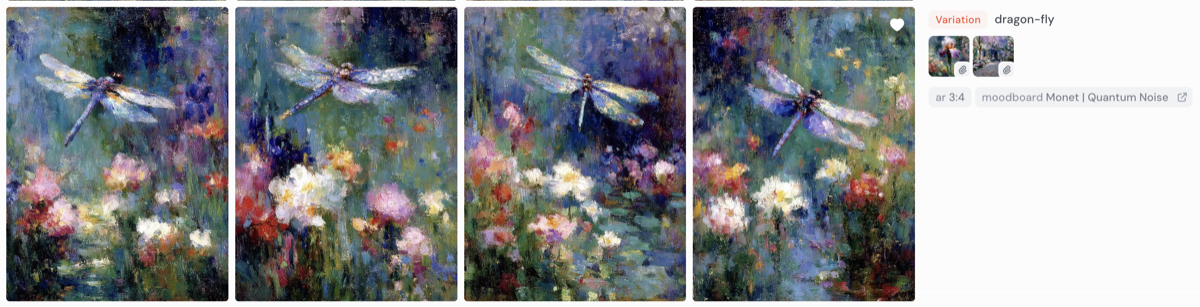
A Midjourney moodboard is a collection of images the model treats as a stylistic field; rather than adjusting the text of the prompt, I adjusted the visual environment the model generated inside of. I built five over the course of the project, each biasing every subsequent generation toward a different region of aesthetic space: Claude Monet (the baseline — too faithful, a very good forgery), Quantum Flowers (my own outputs fed back, higher contrast and overgrown abundance), Quantum Flowers II (whiter, softer, granular as if rendered on degraded film), Monet | Quantum Noise (where the figure and the world first cohered — the bridge that summoned the Botanist), and The Botanist (the one I returned to most: soft, painterly, populated without being portrait-forward, quietly unstable at the surface).
The Algorithm
Why a quantum circuit
The most consequential decision was to use quantum computation as the engine of mutation rather than a classical pseudo-random process — a choice that comes directly from Anadol's Quantum Memories. Classical randomness is simulated: a generator produces outputs that look random but are deterministic functions of a hidden seed. The claim being made — that a memory, once altered, is still a real reconstruction — required the alteration itself to be real. A quantum measurement offers exactly that: its outcome is not chosen from a pre-existing list but drawn from a genuinely probabilistic distribution rooted in subatomic physics. A system meant to model reconstruction should itself be reconstructive in its mechanics.
Encoding memory into the circuit
Each character of the input is converted to its ASCII value and mapped to a rotation angle, θ = ASCII(c)/128 × π, applied to a qubitQubit — the quantum version of a bit. Where a bit is just 0 or 1, a qubit can hold a blend of both at once until it is measured. via an RY gate. A preceding Hadamard gate places each qubit in superpositionSuperposition — a quantum state that is a blend of several possibilities at the same time, rather than one definite value, until a measurement forces it to a single outcome.; CX gates entangleEntanglement — linking qubits so the state of one depends on the others; measuring one instantly constrains the rest. adjacent qubits before measurement. Each step maps to the cognitive frame: the Hadamard establishes the precondition for reconstruction (a state that is neither 0 nor 1 — the ambiguity of a memory about to be recalled); the RY rotation encodes the semantic content (the circuit becomes biased by the memory); the CX entanglement mirrors spreading activation in semantic networks; and the measurement collapses the biased, entangled superposition into a single bitstring — the moment of recall. The circuit is run for a single shot: it commits to one outcome and treats it as the recalled memory, the way a person delivers a single reconstruction as if it were the memory.
Mutation as the locus of alteration
The bitstring isn't the output — it's the intermediate signal that drives word-level mutation. The word is the unit of alteration because the clinical literature identifies it as the primary unit of semantic substitution. Two operations map directly onto the two clinical mechanisms: synonym replacement to semantic paraphasia (a word swapped for a neighbour in the semantic network), and modifier injectionto confabulation (a descriptor that wasn't in the original is inserted — fluent, plausible, not quite true). Each bit decides whether its word mutates (1) or is preserved (0), so some words drift and others survive — partial alteration, matching the clinical picture.
The Architecture
The app is intentionally thin: a Next.js front end and two API routes, with nothing a user submits ever persisted.
| Layer | What it does |
|---|---|
| Stack | Next.js 16 · TypeScript · Tailwind · shadcn/ui, deployed on Vercel. |
/api/transform | Runs the quantum circuit and the word-mutation pass; returns the mutated prompt, the bitstring, and a per-word trace. |
/api/generate | Hands the mutated prompt to a latent diffusion model (Dreamshaper XL Turbo on Replicate) and polls until the image is ready. |
| Persistence | None — everything happens inside a single request-response cycle and disappears when the tab closes. |
| Interface | The landing page is the app: a portrait, the title, one text field. On submit, a slow six-step circuit animation, then the image beside the original and mutated prompts and a per-word table. |
Disclaimer
AI tools played three distinct roles across the project. At the research layer, Midjourney structured the pre-production visual exploration — the moodboard feedback loop and the character study of the Botanist. At the production layer, Replicate with Dreamshaper XL Turbo renders every image a user sees, while IBM Qiskit Aer runs the quantum circuit at the centre of the algorithm. At the delivery layer, Claude Code drove the iterative build of the Next.js app, Claude generated the mutation dictionaries and collaborated on drafting the report, and Prism compiled the final LaTeX document. Across all three, the pattern was the same: I specified the direction, the model proposed candidates, and I curated — no component was submitted without human review.
Conclusion
The project treats memory as a material with known failure modes and renders those modes as an image. It does not simulate dementia and it is not a clinical tool. What it does is stage, in a single interaction, the condition dementia makes visible at the edge of a life: memories are always partly reconstructed, partly substituted, partly not ours. The question of where ours ends is not a medical one but an existential one, and the artefact is designed to sit with it rather than answer it.
My grandmother cannot use the artefact described here, and that limitation is part of the work. The Botanist is for those whose memories are still accessible — a rehearsal, at the scale of a single click, for what the rest of a long life will do anyway.